
Anatomy of a Process
by Dennis J. DeSantis and Nicholas C. Laudato
Introduction
The overall mission of higher education includes teaching, conducting research, providing community service, and disseminating knowledge. To support this mission, institutions maintain an administrative infrastructure that performs a variety of work activities such as payroll, purchasing, etc.
In higher education institutions, as in commercial and industrial organizations, we perform the valued work that defines us through business or work processes. Our business processes are comprised of the steps necessary to produce our products and services. Due to ever-changing conditions, we constantly need to either improve or reinvent our work processes.
A critical prerequisite to achieving this improvement is to understand the anatomy of a process. The purpose of this document is to provide the fundamental concepts necessary to obtain this knowledge.
Anatomy of a Process is organized into three sections.
- The Definitions Section explains background information about processes and defines what we mean by a process.
- The Components of a Process Section provides details on the individual components of a process.
- The Characteristics of a Process Section uncovers key characteristics of processes.
Anatomy of a Process evolved from initial research conducted as part of the University of Pittsburgh’s Information Architecture and Process Innovation Project. This research is applicable to all business processes and operational functions of a higher education institution.
Key concepts in this approach are supported by the following seminal literature:
- Rummler, G. A., & Brache, A. P. (1995). Improving Performance: How to Manage the White Space on the Organization Chart. Jossey-Bass.
- Hammer, M., & Champy, J. (1993). Reengineering the Corporation: A Manifest for Business Revolution. Harper Business
- National Institute of Standards and Technology (NIST). (1993). Integration Definition for Function Modeling (IDEF0). Federal Information Processing Standards Publication 183.
Definitions
About Processes
Processes happen around us continually. They are built around tasks such as ordering an item in a catalog over the telephone or online, working out at our favorite spa, or scheduling a Saturday tee-time at the last minute. Most business processes, like the processes mentioned, are the lifeblood of organizations.
In a business environment, gaining an advantage among competitors is critical to the survival of the organization. In a higher education environment, offering efficient and effective processes for students and parents help create a positive and productive image of the institution.
One of the important keys to survival is how an institution utilizes its processes in the performance of its mission. Walt Disney, in response to a question about his secret to success, said this:
Do something so well that people will pay to see you do it again.
Institutions need to take Mr. Disney’s philosophy to heart and ensure that the processes they create are not only “Disney-like,” but, more importantly, the processes executed to create such services that are something that people would pay to receive.
There are a plethora of articles written about the definition of a process, process improvement, process innovation, process mapping, and business process re-engineering. Little is written about the “properties” of a process. This series of articles will clearly define the properties of a process. These properties are necessary to clearly document a process as well as its process map.
Definition of a Process
Let’s first define what a process is. Basically, a process is a series of steps designed to produce a product or service. More precisely:
A process is a logical and finite set of observable, coordinated, and interrelated (or hierarchical) work activities utilizing input, that when performed in a pre-defined series, produces output.
Organizations are typically structured into functional work areas. Organizations are thus viewed as a series of specialized vertical organizational structures, each responsible and optimized for a defined set of functions. All work is based upon this set of vertical compartments. For example, in higher education, distinct functional units are typically responsible for the functions of recruitment, admissions, financial aid, registration, billing, etc. This traditional organizational structure is not unlike organizational structures found in other industries.
Processes have internal and external customers and are independent of an organization’s functional boundaries. All the steps in a process may be contained within one functional area, but most important processes are cross-functional, spanning the white spaces between the boxes on an organization chart. For example, the procurement process goes well beyond the purchasing department, originating in end-user departments and intimately involving functional administrative offices for approval, central receiving, accounts receivable, accounts payable, etc.
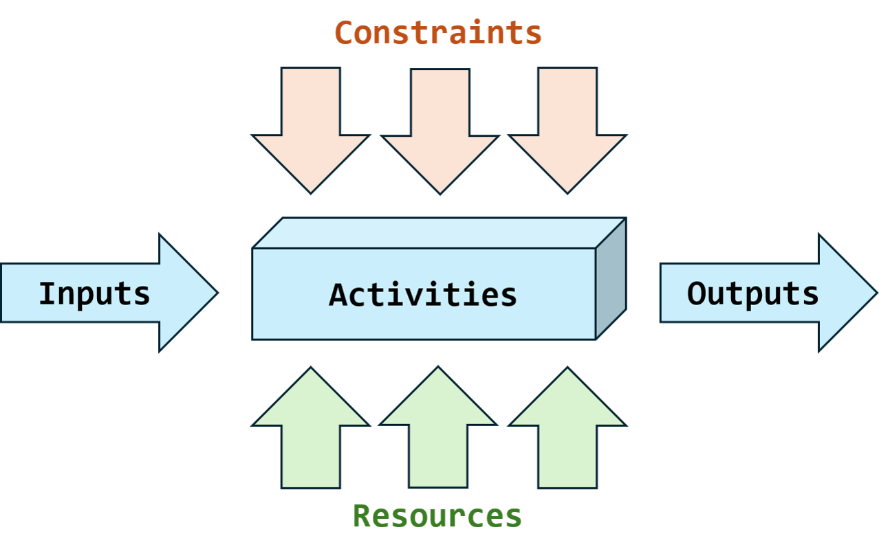
The outputs of a process are generated by a transformation of its inputs. As displayed in the following figure, activities are limited by the resources available to work activities, and the constraints imposed by mandates (policy, laws, and regulations).
There are many processes found within any given organization. Some of these processes are more critical to the survival of an organization than others. The processes that are critical to organizational survival are known as core or primary processes. Other processes are known as support processes.
Processes have a definable beginning (referred to as the "start"), and a definable end (referred to as the "conclusion"). Most processes are inherently cross-functional; that is, they cross functional organizational lines. Therefore, a process view of an organization is horizontal in nature, not vertical.
The detailed components of a process are:
- Inputs
- Triggers, data, and transactions
- Execution of work
- Constraints, resources, and mandatory/optional work activities
- Outputs
- Outputs and outcomes
Note that triggers start, and outcomes conclude, a process. See the figure below.
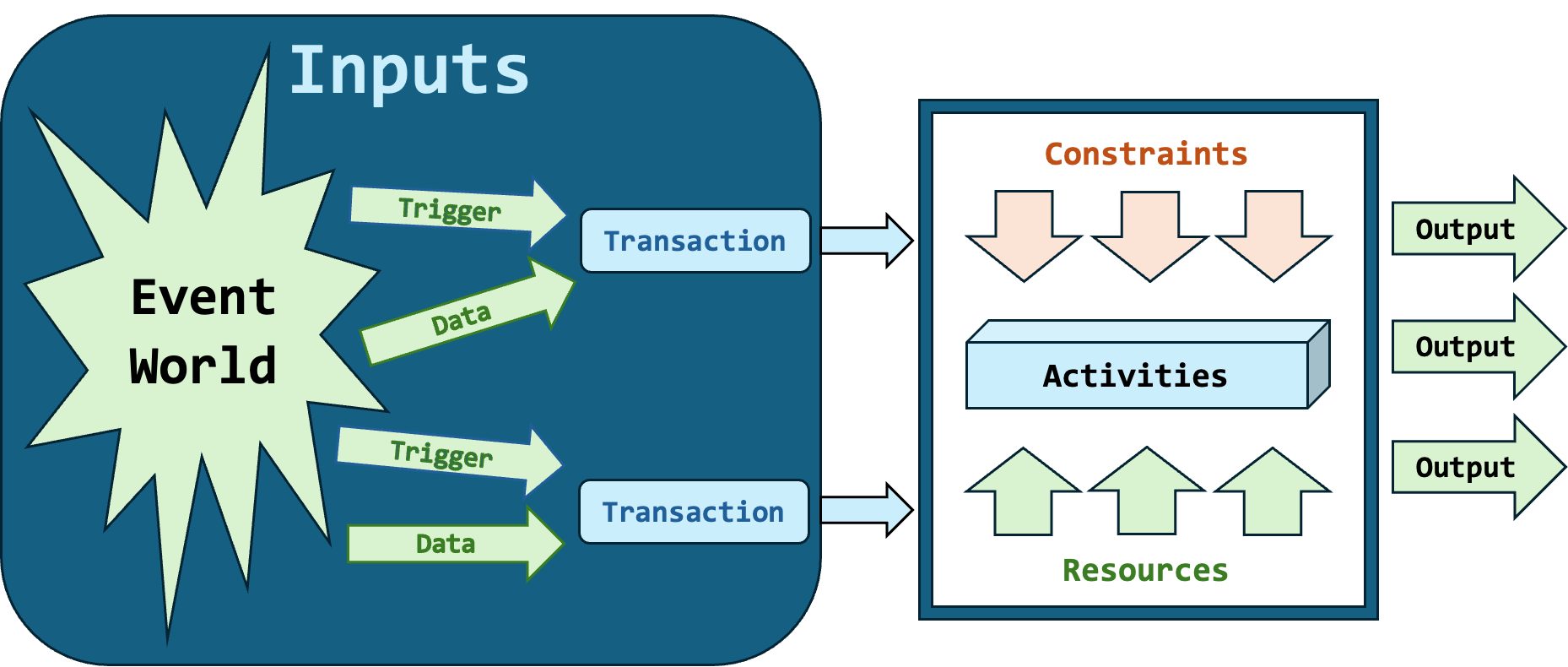
Any process must produce at least one output that, in and of itself, is not primarily used as input to another activity. Its purpose is the output itself; its purpose is not to trigger another process. This type of output is known as an outcome. Outcomes must have value to the enterprise other than existing as a trigger for another activity. That is, an outcome must be independent, valuable, and usable.
For example, procurement is a process. The result (one of the outcomes) of a procurement process is the acquisition of a product (or service). The product is usable by itself, and the primary purpose of attaining the product is not to trigger another event.
If one looks at other activities (sub-processes, tasks, etc.), the outputs all do (or should) primarily act as triggers to other events and have no general utility or worth to the enterprise otherwise. For example, the creation of a purchase order within a procurement process has one purpose, to continue the series of steps for acquiring some good or service. In and of itself, a purchase order has no other value or worth to the enterprise.
Another example is the issuing of photo identification cards to employees. The card itself has little value for the organization, but its use in gaining physical access to buildings, offices, parking lots, etc. offers very valuable input to security access processes.
It is important to note that any given process can occur continuously within the environment. Additionally, at any time, separate occurrences of a process could be at different stages of that process. For example, a snapshot of a procurement process will reveal that different goods and services are being planned, ordered, shipped, received, and invoiced simultaneously.
Components of a Process
Processes exist within an environment. They are initiated by transactions triggered in an event world and driven by data. The main components include:
- Inputs,
- Execution of work, and,
- Outputs.
Inputs
The inputs to a process take the form of transactions containing data and triggers.
Transactions
Transactions may be viewed as specialized work activities that utilize a collection of data, grouped in such a way that it is meaningful to a work activity, and necessary to perform a business operation. Transactions, as they flow through a process, may generate and/or collect additional data.
Data
Data are the values of attributes associated with a trigger or transaction. They are dependent upon the event that created the trigger for a transaction and may include such attribute values as date, time, request type, requester name, account number, reference number, quantity, etc. The data associated with a trigger may not be adequate to form a transaction and additional data may need to be acquired from the event world to initiate a transaction. Traditionally, paper or electronic forms have been utilized to record the data associated with a trigger in order to initiate a transaction.
The data values are simply sets of numbers, letters, symbols, etc. used to represent events occurring in the environment, and are organized according to formal rules and conventions. For example, "14657" is a set of data. In the context of a procurement process, this set of data may represent a specific purchase order number. In the context of a budget monitoring process, this set of data may represent a reference number used to uniquely identify a charge to a specific account.
Triggers
Triggers are always data rich in that there is enough data accompanying triggers to initiate the process. Data may exist internal to the environment or imported into the environment from outside.
Triggers may cause an activity (action) to occur. There are three general types of triggers:
- Request/demand triggers usually are created as output from other processes or activities that signal the beginning of a new process. They may be generated internally or externally.
- Time-dependent triggers are based upon calendar events such as the beginning of a new recruitment season, a new calendar year, or fiscal year.
- Conditional triggers are those events governed by policies, rules, regulations, or laws and may be generated internally or externally.
Execution of Work
After a process has been triggered by one or more transactions, the work of the process begins. This “execution of work” is constrained by a set of forces and utilizes a set or resources.
Constraints
Constraints can be characterized as those policies, rules, regulations, and laws that define the boundaries or limitations of a process. Constraints can be classified as:
- External to the enterprise, such as,
- The Family Rights and Privacy Act of 1974,
- The Gramm-Leach-Bliley Act,
- The Health Insurance Portability and Accountability Act of 1996,
- IRS regulations, etc.,
- Enterprise policies,
- Division policies, and
- Departmental policies.
There are also varying types of constraints. The most common constraints are authority, punitive, availability, acceptability, and scheduling.
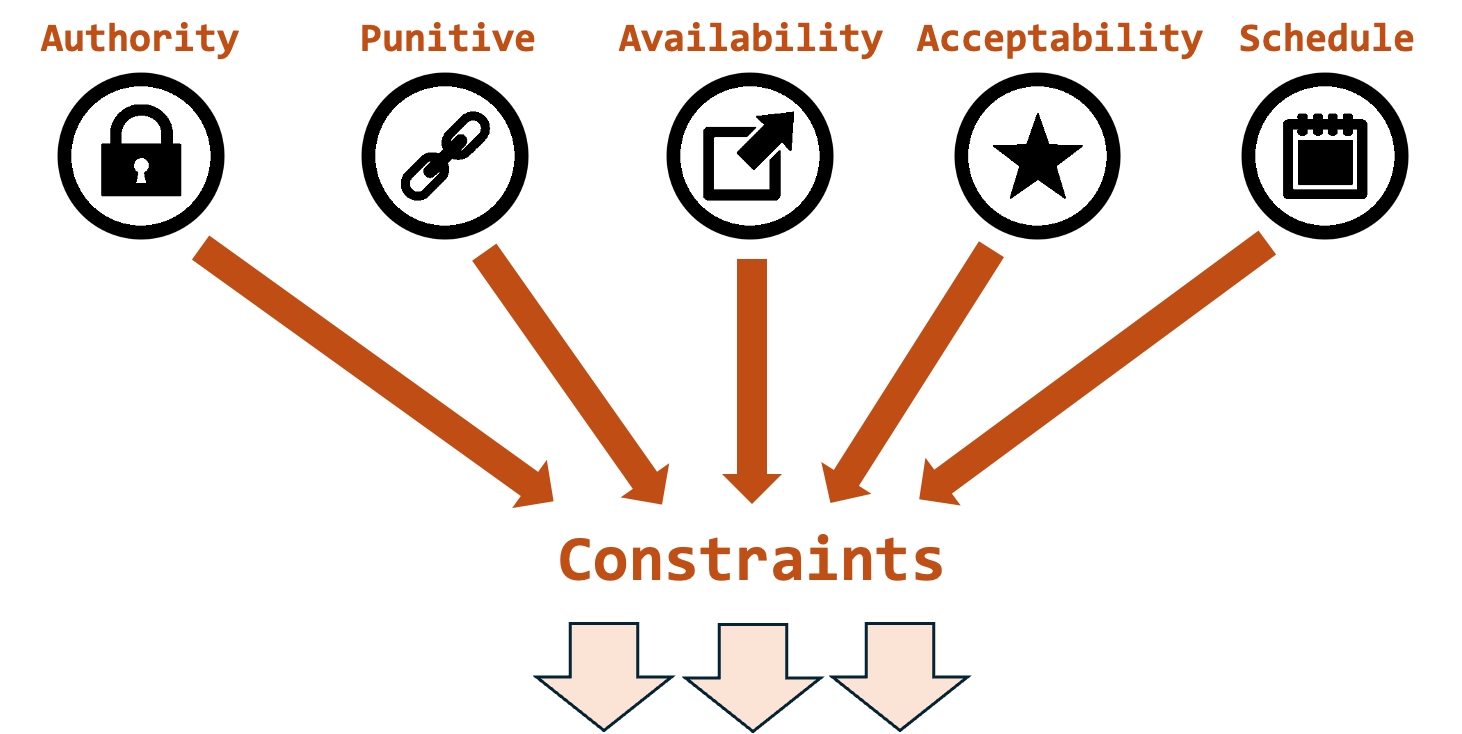
- Authority Constraints: Employees must be given authority to perform certain tasks and activities. For example, only certain employees may have authority to access payroll information and not every employee is given the authority to negotiate contracts or purchase items.
- Punitive Constraints: Punitive actions are normally incurred when practices are not adhered to. For example, employees taking excessive leave may be docked in their next paychecks.
- Availability Constraints: Limitations to activities and processes are sometimes based upon availability. For example, employees authorized to purchase consumables may be restricted to a set of vendors for economic reasons. Likewise, the organization may be restricted to a small set of travel agents for economic reasons. Other examples include the number of inventory items available in stock to a customer ordering by telephone or over the internet.
- Acceptability Constraints: Some activities invoke constraints based upon some evaluative or criterion-referenced standards. For example, student grading standards in higher education are enforced as a measure of successful or unsuccessful performance. There is an acceptable standard by which student academic performance is measured.
- Scheduling Constraints: Because processes are temporal in nature, they usually demand the execution and sequencing of activities within a window of time that necessitates scheduling of some form. Scheduling an appointment with your accountant for income tax preparation and submission must be done within a specific calendar window if your submission is to be filed on time. Budgets exist within fiscal years, and windows of time are created for annual budget preparations.
Resources
Resources are the "tools" necessary for the execution of any business operation. There are six general types of resources found in any process. They are people, time, equipment, consumables, space, and fiscal support.
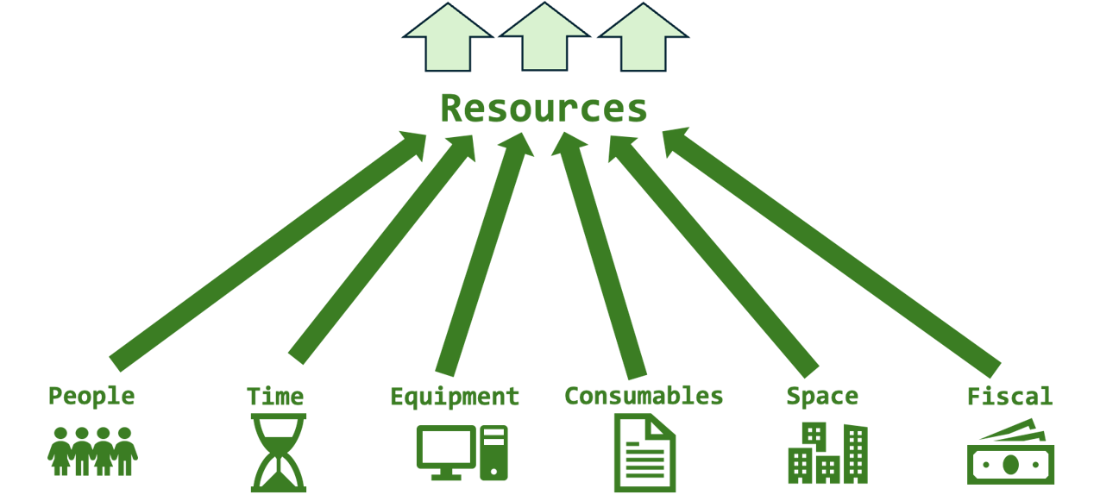
- People: Humans involved in any business operation can be classified as either producers (or providers), or consumers (or customers) of the process. The performance and quality of the process is directly affected by the preparatory and continual training programs available to the providers.
- Time: Processes are temporal in nature. That is, an occurrence of any process takes place through time. In most instances of a process, it is time that helps define its boundaries (process start and conclusion).
- Equipment: Equipment is defined as any mechanical or electronic device used in the execution of a process. Also included is the information technology necessary to support the business process.
- Consumables: Most consumables used in a process help to foster communication among providers and consumers. Consumable items include paper, forms, publications, etc.
- Space: Process occurrences are temporal in nature and utilize space. Space is an important resource since it imposes physical boundaries, and sometimes limitations, around the execution of work activities.
- Fiscal Support: All business operations cost the enterprise in the form of dollars. Salaries, equipment and maintenance, consumables, and overhead costs limit the number of viable alternatives the enterprise has to subsidize its business operations.
Outputs
The main goal of any process is to produce, from a set of inputs, one or more outputs of greater added value than the inputs. Outputs of an activity are in the form of information, products (tangible or intangible), and/or services provided.
Outputs are either temporary or permanent. Temporary outputs are usually interim products or services that are meant to act as triggers necessary to start another activity. Permanent outputs generally have value or worth not only to the provider or customer, but to the enterprise as well. These permanent outputs are known as outcomes.
Characteristics of a Process
Processes are characterized by the following:
- Ownership
- Boundaries
- Flow of Work
- Stages of a Process
- Control Points and Measurements
- Process Deviations
- Interactions among Processes
- Measures of Process Performance
- Speed
- Service
- Quality
- Cost
- Knowledge Management
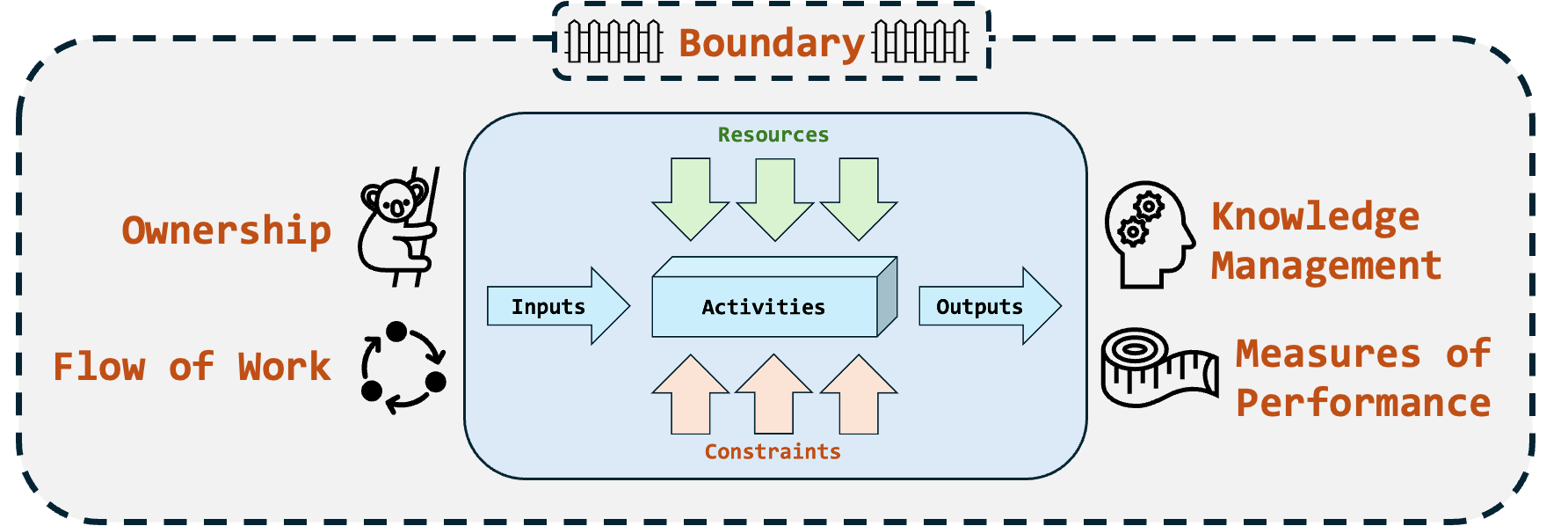
Ownership
Ownership is important to any process to define responsibility and accountability, facilitate problem resolution, and provide authority to make changes.
Complex, cross-functional, service-based processes are usually characterized by ambiguous ownership. This is common in complex processes where numerous interfaces across functional boundaries exist.
Establishing and assigning ownership is fundamental to facilitating process improvement or innovation.
Boundaries
The boundaries of a process define the limits (start and conclusion) of work activities. These boundaries are critical in identifying the inclusion of interfaces, constraints, and requirements of input and output.
Flow of Work
A process is a construct representing a pre-defined set of work activities. These activities are performed in a coordinated order, that is, in some pre-defined sequence, to produce some output or outcome.
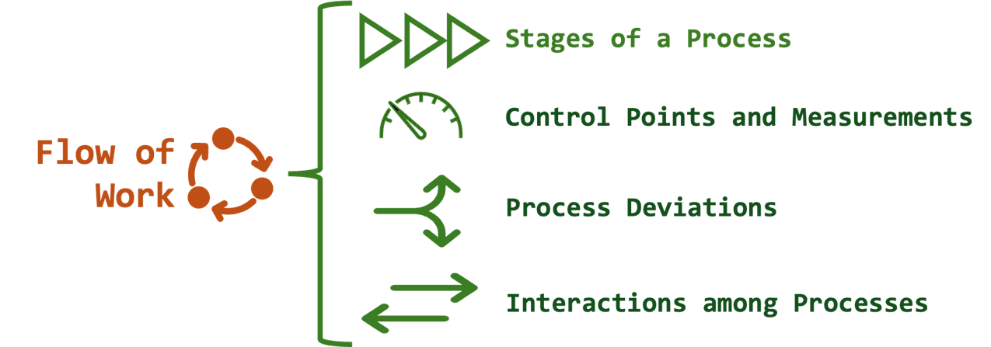
Flow of Work can be analyzed along the following characteristics:
- Stages of a Process
- Control Points and Measurements
- Process Deviations
- Interactions among Processes
Stages of a Process
Central to understanding the workflow of a process are the stages in the process life cycle. Processes typically have four stages: preparation, execution, evaluation, and disposition.
- The preparation stage includes those work activities that prepare the provider and/or consumer for the main purpose of the activity.
- The execution stage includes those work activities which make up the essence of the activity.
- The evaluation stage is composed of work activities which are performed to establish the acceptability of the output and/or performance.
- Control Points and Measurements are steps found in processes associated with evaluating the process. Validating input, auditing data, monitoring throughput, and checking output are examples of control points and measurements. These characteristics are essential to managing a process.
- Process Deviations: The performance of a process sometimes does not meet the necessary requirements of the input or output. In these cases, deviations to the normal flow of work are observed. The evaluation of control points and/or measurements usually signals deviations.
- The disposition stage is composed of those work activities that end the operation. They normally include recording or documenting the occurrence of the activity, returning equipment to a neutral state, etc.
Interactions among Processes
Processes do not exist within an organization as isolated islands of functionality. They continually interact with each other supplying necessary inputs, resources, and outputs. For example, in the procurement process, some activities rely on the purchasing of goods, the central receiving area accepting delivery of goods, and the accounts payable department responsible for the payment of goods received.
Measures of Process Performance
Process owners are accountable for the ongoing evaluation of their processes. Evaluation of process performance, in its simplest terms, is the determination of the efficiency and effectiveness of a process. The evaluator may be an expert of the process, the process owner, or an outsider. This type of evaluation may take several forms, including the use of qualitative and/or quantitative methods.
Qualitative methods are subjective accounts of the process as viewed by the evaluator. It may take the form of a case study or narrative based upon a series of interviews with the people involved in the process, and/or observations of the process itself.
Quantitative methods are objective accounts of the process as viewed by the evaluator. It will usually contain data representing objective measurements of the process relevant to efficiency and effectiveness.
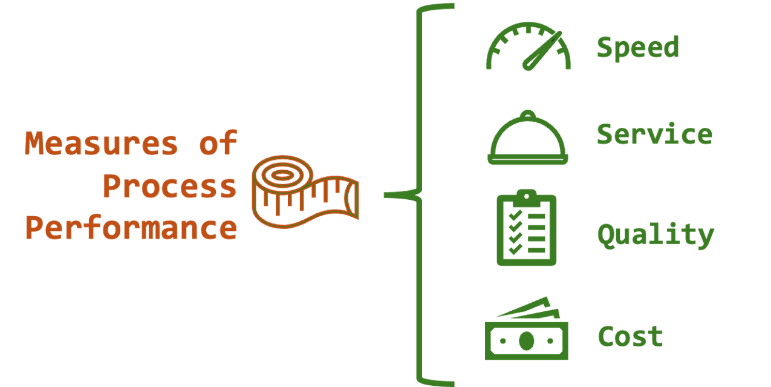
Measures of process performance should focus upon speed, service, quality, and cost.
- Speed: Speed is defined as the time segments between each step of the process, the amount of time spent within a process step, and the overall time used for the execution of the whole process. Time lags are usually discovered when communications are sent through the mail, sitting in "in-baskets", turnaround time for system processing, and customer waiting time for service. Other characteristics that may impede the speed of work activities are the type and number of existing constraints influencing the process, as well as the nature and amount of resources assigned to the process.
- Service: All processes have customers, either internal to the environment or external. Most outputs of a process are produced for the use or consumption of the customer. Measures of customer satisfaction are essential to the evaluation of process performance.
- Quality: Quality may be defined as the degree of excellence. Measures of quality should center on the properties of the inputs and outputs as compared to existing standards defined by the process owner.
- Cost: There are always associated costs (direct and indirect) of a process. Employee salaries, equipment, space and consumables are the major direct costs of most processes. Missed discounts, and lost customers are some examples of indirect costs.
Knowledge Management
Performers involved in any process rely on a body of knowledge necessary to perform activities at a certain level of acceptable performance. This knowledge is usually gained through various formal and/or informal training programs offered by the enterprise. This knowledge usually includes the steps necessary to perform activities as well as knowledge related to the various constraints placed upon the process.
Summary
This document presents a comprehensive framework for Business Process Management (BPM) adapted for higher education yet easily generalizable to commercial and industrial enterprises. It provides a comprehensive overview of the anatomy of a process in higher education institutions, detailing its definition, components, and characteristics. It emphasizes the importance of understanding processes to improve efficiency and effectiveness in organizational missions.
The document uses diagrams and definitions to transition from high-level concepts (e.g., cross-functional workflows) to specific operational components (e.g., inputs, triggers, constraints, resources, outcomes).
A clear understanding of the anatomy of a process is a critical prerequisite to the challenges of improving or reinventing our business processes using effective techniques such as process analysis, process mapping, and process reengineering.